
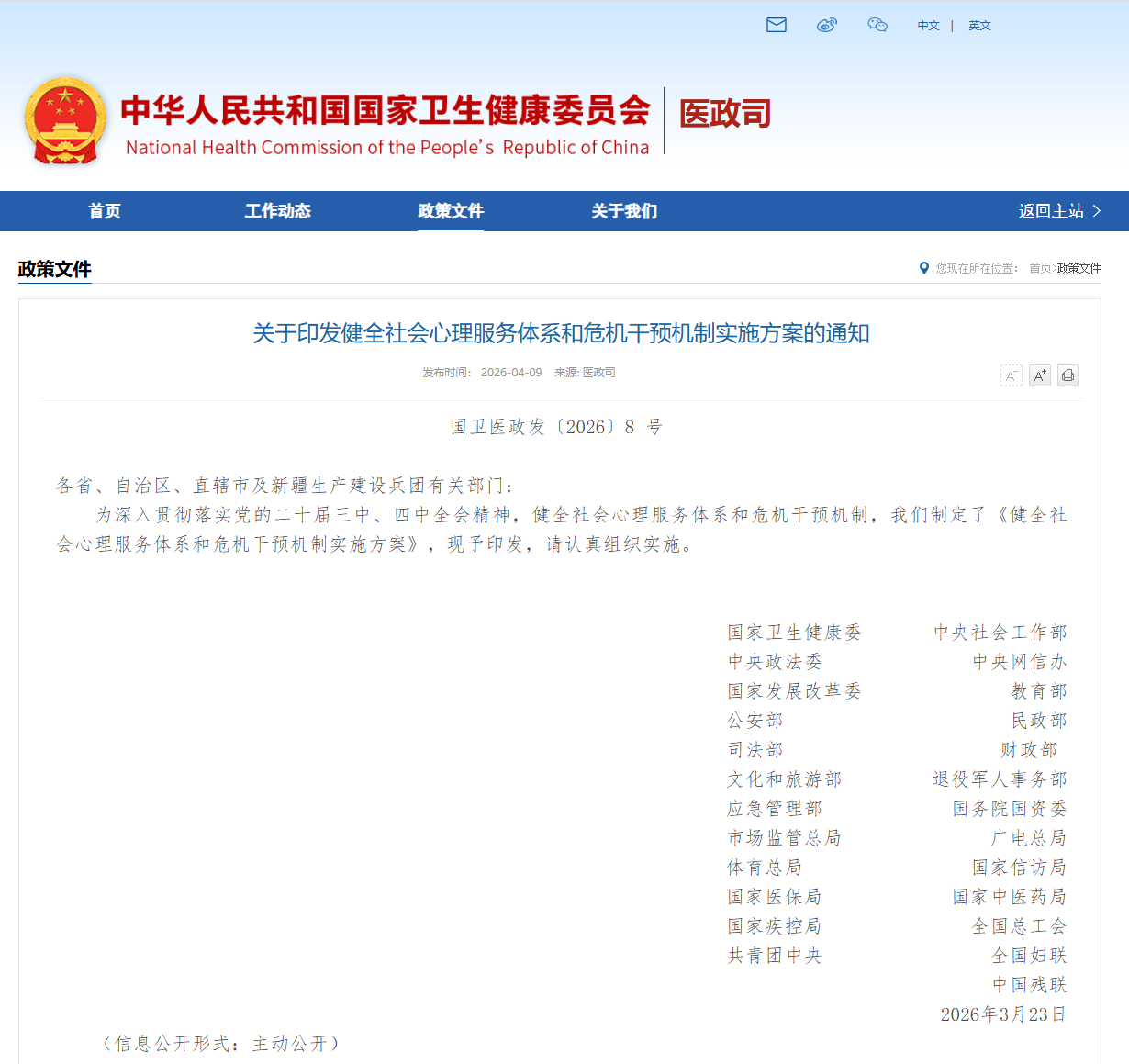
To fully implement the "Mental Health Law of the People's Republic of China" and the "Decision of the CPC Central Committee on Further Deepening Reform Comprehensively and Promoting Chinese Modernization," this plan is formulated to improve the social psychological service system and crisis intervention mechanisms, enhance social governance effectiveness, and contribute to building a higher-level Safe China and Healthy China.
I. General Requirements
Guided by Xi Jinping Thought on Socialism with Chinese Characteristics for a New Era, implement the spirit of the 20th National Congress and all plenary sessions of the 20th Central Committee. Strengthen inter-departmental collaboration and social participation to integrate psychological services into the social governance system and the construction of a Safe China and Healthy China. Build a new pattern of co-construction, co-governance, and shared benefits in social psychological services, fostering a societal mindset that is self-confident, rational, balanced, and positive.
By 2030, a comprehensive social psychological service system and crisis intervention mechanism covering the entire population throughout their life cycle will be substantially established. More than 80% of administrative villages and urban communities will have counseling rooms or social work offices providing psychological services; all types of schools at all levels will have dedicated psychological service facilities (such as counseling centers) and strengthen the development of full-time and part-time mental health education teachers; government agencies at all levels, state-owned enterprises and institutions, and various non-public economic organizations will create conditions to provide psychological services for employees; public psychiatric hospitals at all levels and counties (districts) will each have at least 1 hospitals offering outpatient psychological services; provincial-level 12356 psychological assistance platforms will be established in every province (autonomous region, municipality directly under the Central Government), and each province along with its prefectures (cities, leagues) will have teams for psychological crisis intervention and psychological assistance.
II. Key Tasks
(1) Strengthen and solidify social psychological service platforms.
1. Strengthen grassroots mental health services.
Leverage grassroots comprehensive governance centers, party and mass service centers, new era civilization practice stations, and community drug rehabilitation offices to establish psychological counseling rooms or social work studios (stations), providing residents with psychological services. Psychological service providers—including counselors, social workers, grid members, people's mediators, and volunteers—offer timely psychological support and comfort to resolve conflicts at the grassroots level. For individuals requiring medical intervention, guide or refer them to appropriate institutions in accordance with laws and regulations for professional care. (Responsible departments: Central Social Work Department, Central Political and Legal Affairs Commission, Ministry of Public Security, Ministry of Civil Affairs, National Health Commission, All-China Federation of Trade Unions, Communist Youth League of China, All-China Women's Federation, and China Disabled Persons' Federation, each according to their respective duties.)
2. Strengthen mental health services in the education system.
Standardize school mental health service facilities (e.g., counseling rooms) and strengthen the team of full-time and part-time mental health education teachers. Enhance professional knowledge and skills training for mental health educators, counselors, and homeroom teachers. Scientifically design mental health curricula and textbooks to build a cohesive mental health education system across primary, secondary, and higher education levels. Uphold moral education and holistic development to promote student well-being; continue implementing the "Double Reduction" policy and ensure adequate physical activity time. Strengthen life education, adolescent development education, and resilience training to improve students' ability to adapt to their environment, regulate emotions, and cope with stress, thereby enhancing psychological resilience and immunity. Conduct regular mental health assessments and apply results scientifically and normatively to establish a monitoring and early warning system. Establish mechanisms for identifying major psychological issues, referring students for medical care, and facilitating return to school after recovery. (Led by the Ministry of Education; the Ministry of Civil Affairs, National Health Commission, and China CDC to carry out responsibilities in accordance with their respective roles.)
3. Strengthen psychological services for government agencies and enterprises.
Encourage large government agencies and state-owned enterprises to establish dedicated or依托 existing departments for psychological counseling. Smaller organizations can provide mental health services through outsourced services, workshops, and lectures to help employees understand and master techniques for emotional regulation and stress management, thereby enhancing their self-adjustment capabilities. Public security, judicial administration, and petition departments should leverage industry-specific characteristics to set up psychological counseling rooms in facilities such as police detention centers and prisons, offering mental health support to both internal staff and individuals under supervision. (Each department is responsible according to its assigned duties.)
4. Improve mental health services within the healthcare system.
Strengthen the five-tier mental health and psychiatric service system at the national, provincial, municipal, county (district), and township (community) levels. Each province, city, and county (district) shall establish or designate mental health and psychiatric service institutions to deliver services within their jurisdictions. Public psychiatric hospitals must operate outpatient psychological clinics. General hospitals, traditional Chinese medicine hospitals, children's hospitals, maternal and child health care centers, community health service centers (stations), township health centers, and other medical institutions may establish outpatient psychological clinics or provide mental health services based on their functional roles, patient needs, and capabilities. We encourage larger, comprehensive grade-2 and above psychiatric hospitals to set up relatively independent mental health service centers. Fully implement the "integrated mind-body treatment" approach across all clinical departments. Encourage qualified primary medical institutions to integrate mental health services into family doctor contract programs. During dynamic adjustments of medical service pricing, consider prices for psychotherapy and psychological counseling to ensure they reasonably reflect the value of technical labor. (Led by the National Health Commission; with the National Development and Reform Commission, National Healthcare Security Administration, National Administration of Traditional Chinese Medicine, and National Center for Disease Control and Prevention fulfilling their respective responsibilities.)
5. Promote the standardized development of socialized psychological services.
Formulate and develop management systems and industry policies for social psychological service institutions, strengthen standard-setting and practice supervision, and regulate the provision of psychological services. Include mental health laws and regulations, humanistic ethics, fundamental theories of psychology, and practical skills in psychological services as key components of practitioner training. Comply with legal requirements to strictly define the scope of services offered by social psychological service institutions; prohibit activities such as psychotherapy, diagnosis, and treatment of mental disorders. If potential mental disorders are identified during service delivery, refer or guide clients to medical and health institutions for further diagnosis and treatment in accordance with laws and regulations. Cultivate a batch of social psychological service institutions characterized by a warm environment, standardized practices, reliable quality, and strong reputation. (Responsible agencies: National Health Commission, State Administration for Market Regulation, etc., according to their respective duties.)
(II) Strengthen the social and psychological services workforce.
1. Strengthen the training of professionals in psychological services.
Strengthen the training of applied mental health service professionals and improve a cohesive talent development mechanism that integrates degree education, continuing education, and vocational training. Encourage higher education institutions to establish interdisciplinary programs in medicine, education, psychology, and related fields; explore talent cultivation models and teaching methods suited to China's national conditions; and train qualified mental health service professionals. Support relevant majors—including medicine, education, ideological and political education, rehabilitation, and social work—in offering psychology courses to comprehensively enhance students' theoretical knowledge and competency in mental health. Adhere to classified guidance and phased implementation to progressively build a multi-tiered workforce of mental health service professionals, including psychiatrists (including practitioners in traditional Chinese medicine, unless otherwise specified), psychological therapy technicians, psychological counselors, mental health education teachers, and social work specialists. (Led by the Ministry of Education; with coordinated responsibility among the Central Social Work Department, Ministry of Civil Affairs, Ministry of Human Resources and Social Security, National Health Commission, State Administration of Traditional Chinese Medicine, and National Center for Disease Control and Prevention, each acting within its respective mandate.)
2. Strengthen the mental health workforce in medical and health institutions.
Integrate mental health and psychiatric care knowledge into standardized residency training, physician licensing exams, periodic assessments, and professional title evaluations. Ensure staffing requirements for psychiatrists, nurses, psychotherapy technicians, and counselors in healthcare institutions. Standardize psychiatrist retraining programs and conditional registration to strengthen the psychiatric workforce. Develop specialized nurses, pharmacists, rehabilitation technicians, hospital social workers, and volunteers to enhance overall mental health service capacity. Strengthen staffing of prevention and control personnel in primary healthcare institutions to improve grassroots mental health and psychiatric care capabilities. Conduct targeted training to elevate standardized and specialized diagnosis and treatment of mental disorders in psychiatric departments, while improving other clinical departments' ability to early identify, screen, and provide initial interventions for common mental health issues. (Led by the National Health Commission; responsible agencies include the Ministry of Human Resources and Social Security, the National Administration of Traditional Chinese Medicine, the National Disease Control Administration, etc., according to their respective responsibilities.)
3. Standardize the management of social psychological counselors.
Establish a management system for social psychological counselors, clarifying the responsibilities of relevant departments. Strengthen requirements for professional qualification management, training and assessment, title evaluation, and supervision. Leverage the role of industry organizations to regulate practitioners' conduct and improve service quality. Implement an information registration system for personnel in the social psychological counseling sector, promptly publish relevant information to the public, and enhance social oversight. (Respective departments are responsible according to their duties.)
4. Cultivate and expand the volunteer workforce for social psychological services.
Strengthen specialized training for volunteers to enhance their capacity in providing psychological counseling, emotional support, and relationship adjustment services. Encourage and guide more professional personnel to join the social psychological service volunteer workforce, deepen the substance of volunteer services, and improve service quality. (Responsible departments include the Central Social Work Department, National Health Commission, and others, each in accordance with their respective responsibilities.)
(3) Strengthen mental health services for key populations.
1. Strengthen mental health services for children and adolescents.
Strengthen home-school collaboration to foster sound educational perspectives, equip parents with effective parenting strategies, promote a healthy understanding of academic performance, and cultivate positive, optimistic, and resilient psychological traits in students. Enhance coordination between medical and educational sectors by establishing collaborative mechanisms among primary, secondary, and tertiary institutions with healthcare providers. Build a three-tier mental health service system led by class teachers or counselors, full-time or part-time mental health educators, and psychiatrists, delivering seamless, relay-style support. Optimize social support systems by leveraging community centers (e.g., Children's Homes) and local education organizations to advance community-based mental health platforms for children and adolescents. Encourage professional social workers and volunteers to deliver mental health services to young people. (Led by the Central Social Work Department, Ministry of Education, Ministry of Civil Affairs, National Health Commission, National Center for Disease Control and Prevention, Communist Youth League of China, All-China Women's Federation, etc., according to their respective responsibilities.)
2. Widespread implementation of psychological services for occupational groups.
Strengthen the primary responsibility of employers by providing targeted mental health services tailored to the specific characteristics of different occupational groups. For teachers, physicians, and other established professions, consolidate existing mental health service approaches and scale up proven practices. For newly employed populations, intensify research into their unique job roles and responsibilities, innovate service models and delivery methods, and promote psychological well-being. Ensure comprehensive psychological adjustment training for veterans to enhance their mental resilience and facilitate social integration. (Responsible agencies: General Office of the CPC Central Committee Organization Department, General Office of the CPC Central Committee Social Work Department, Ministry of Human Resources and Social Security, National Health Commission, Ministry of Veterans Affairs, SASAC, All-China Federation of Trade Unions, All-China Federation of Industry and Commerce, etc., according to their respective duties.)
3. Focus on the mental health of specific groups.
Leverage public service facilities such as elderly activity centers, nursing homes, women's homes, child welfare institutions, minor protection and rescue centers, and disability support centers to provide psychological services for specific groups including the elderly, women, children in difficult circumstances, and persons with disabilities. Strengthen psychological care for vulnerable elderly populations, particularly those living alone or with functional impairments. Enhance mental health support for left-behind and disadvantaged children to promote their physical and emotional well-being. Focus on the mental health of women during critical periods such as perinatal and menopausal stages, offering psychological guidance and crisis intervention. Mobilize disability support agencies and social organizations to deliver psychological care services for persons with disabilities and their families. (Responsible agencies: Ministry of Civil Affairs, National Health Commission, Communist Youth League of China, All-China Women's Federation, China Disabled Persons' Federation, etc., according to their respective duties.)
(4) Expand the forms and content of social psychological services.
1. Actively leverage the 12356 psychological assistance hotline.
Continuously improve the work system of the 12356 psychological assistance hotline to ensure stable operations, increase answer rates, and enhance service quality. Strengthen the psychological assistance hotline service network by promoting the establishment of a provincial-level 12356 information platform, improving training for hotline counselors, and advancing standardization and规范化 of services. Enhance data analysis and application of results to guide mental health services across different sectors and populations, and strengthen linkage mechanisms with other service hotlines such as 110. (Led by the National Health Commission; Central Political and Legal Affairs Commission, Ministry of Public Security, etc., responsible according to their respective duties.)
2. Strengthen and effectively utilize the 12355 comprehensive service platform for youth.
Build a "one-stop, comprehensive, and localized" service system. Promote integration with the 12345 citizen hotline platform, strengthen collaborative linkage with the 12356 psychological assistance hotline, deepen case tracking and handling at the local level, and focus on addressing urgent and pressing issues causing psychological distress among adolescents. Enhance the intelligence and professionalism of the 12355 hotline and online platforms. (Led by the Communist Youth League of China; Central Political and Legal Affairs Commission, Ministry of Education, Ministry of Public Security, Ministry of Civil Affairs, Ministry of Justice, National Health Commission, etc., responsible according to their respective duties.)
3. Vigorously promote mental health awareness and education.
Promote the excellent traditional Chinese culture, integrate with the cultivation and practice of socialist core values, and strengthen spiritual civilization construction. Build a well-planned and accessible network of community entertainment and cultural activities venues to meet the public's spiritual and cultural needs. Widely leverage both traditional and new media for science popularization, advocating scientific concepts such as "everyone is the first responsible person for their own health" and "holistic health of mind and body," along with essential health knowledge, to enhance the public's mental well-being. (Responsible agencies: Cyberspace Administration of China, Ministry of Culture and Tourism, National Health Commission, State Administration of Radio and Film and Television, General Administration of Sport, State Administration of Traditional Chinese Medicine, National Center for Disease Control and Prevention, China Disabled Persons' Federation, etc., in accordance with their respective responsibilities.)
(5) Advance psychological crisis intervention and support services.
1. Strengthen the teams for psychological crisis intervention and assistance.
Leverage existing medical and health institutions to strengthen provincial and municipal teams for psychological crisis intervention and assistance. Team composition should include psychiatrists, psychotherapy technicians, counselors, social work professionals, and volunteers, enhancing their professional service capabilities. Conduct regular training and drills to continuously improve skills in identifying and assessing high-risk populations, providing psychological crisis intervention, and delivering psychological support. (Led by the Central Social Work Department, Ministry of Education, Ministry of Civil Affairs, National Health Commission, Ministry of Emergency Management, State Administration of Traditional Chinese Medicine, and China CDC, according to their respective responsibilities.)
2. Provide routine psychological crisis intervention and support services.
Guide media to uphold correct public opinion orientation, ensure scientific, moderate, and stable reporting, balance political and social responsibilities in news dissemination, reject the "traffic-at-all-costs" mindset, foster an environment conducive to positive social attitudes, and reduce the occurrence of psychological crisis events. Fully leverage grid members, social workers, volunteers, and other frontline personnel to conduct routine screenings, promptly identify risk factors such as family changes, unemployment, and school dropout, strengthen intervention and counseling, and achieve early detection, early intervention, and early resolution of risks. When necessary, deploy psychiatrists, psychotherapy technicians, and other professionals from psychological crisis intervention and support teams to provide guidance or assistance. (Led by the Central Social Work Department, the Central Political and Legal Affairs Commission, the Cyberspace Administration of China, the Ministry of Civil Affairs, the National Health Commission, the Ministry of Emergency Management, the State Administration of Traditional Chinese Medicine, the National Center for Disease Control and Prevention, the Communist Youth League of China, etc., according to their respective responsibilities.)
3. Strengthen psychological crisis intervention and support for major emergencies.
Integrate psychological crisis intervention and mental health support into emergency response plans and technical protocols for various incidents. Activate these emergency measures according to established procedures in the event of major accidents, severe natural disasters, or similar crises. Conduct assessments of the psychological impact of incidents to identify affected populations and determine the extent of their needs. Based on assessment results, allocate professional resources appropriately and implement targeted psychological crisis intervention and mental health support services. Ensure effective coordination between psychological interventions and other emergency response efforts to prevent and reduce adverse events. After the emergency phase, continue providing mental health support to relevant individuals through specialized psychological assistance agencies, social work organizations, volunteer groups, and helplines. (Led by the Central Social Work Department, Central Political and Legal Affairs Commission, Ministry of Civil Affairs, National Health Commission, Ministry of Emergency Management, State Administration of Traditional Chinese Medicine, and National Center for Disease Control and Prevention, each according to their respective responsibilities.)
3. Safeguards
Strengthen organizational leadership across regions and integrate the development of social psychological service systems and crisis intervention mechanisms into the overarching plans for Safe China and Healthy China. In areas such as resource allocation, support guarantees, and professional titles and benefits, comprehensively consider the needs of social psychological service system development. Health, social work, education, public security, and Communist Youth League departments at all levels should take the lead, with relevant departments collaborating to implement responsibilities effectively and ensure tangible results in all assigned tasks.
Related Links: Interpretation of the "Implementation Plan for Improving the Social Psychological Service System and Crisis Intervention Mechanism"